How Private Equity Manager Selection, Structure, and Fees Lead to Success
July 21, 2026
Access to private equity has expanded beyond large institutions, but success depends on more than returns. The second article in our private equity series breaks down the three decisions that most determine outcomes, manager selection, structure, and fees, and how evergreen funds have opened the asset class to individual investors.
The first article in our private equity series made the case for private equity as an asset class: its return potential, diversification benefits, and the structural reasons it has historically outperformed public markets. The question that follows is more practical: how do you access it in a way that actually delivers those benefits?
There are three key decisions that play a significant role in your success with private equity:
Who manages the capital?
Through what structure?
At what cost?
In this article, we’ll explore how you can get these right, and what actually determines success.
Why Manager Selection Matters
Private equity performance varies considerably across managers and vintage years.
This variability presents two distinct hurdles:
Identifying which general partners have the skill and track record to outperform.
Gaining access to their funds.
In our first article, we outlined three return drivers: operational expertise applied directly to portfolio companies, alignment between owners and management, and access to high-growth businesses at attractive valuations. It’s important to note that unlike selecting funds, these drivers aren’t equally available to all managers—they depend on capabilities, networks, and judgment that some general partners have developed over decades, while others have not.
For investors accessing private equity through funds rather than direct company ownership, the question isn’t which companies to own directly, but which general partners have the skill, networks, and track record to identify and build value in the right companies on your behalf.
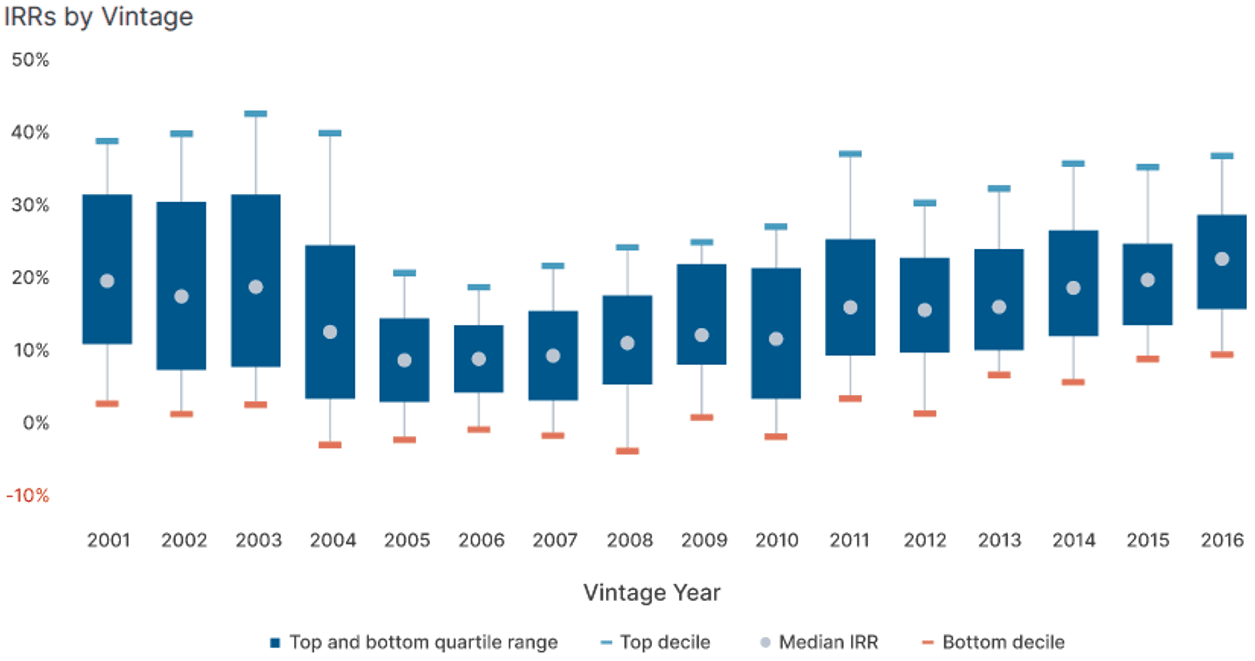
The chart below illustrates just how consequential this decision can be:
A vintage year is when a project or company first receives investment capital, marking the start of its funded growth. Because returns vary with economic conditions at that moment, investors use the vintage year to help estimate potential ROI, spot broader market trends, and judge valuation. It also reflects where a company sits in the business cycle, which can shape its long-term performance.
Source: Investopedia, 2026
Private Equity Returns by Vintage
Source: PitchBook, Data as of June 30, 2021
This chart makes two things clear. First, the median return across vintage years supports the case for private equity as an asset class. Second, the distance between the median and the bottom decile is substantial, underscoring why being in the wrong fund can lead to a materially different outcome than being in an average one.
5 Ways Investors Access Private Equity
Even if you’ve identified the right managers for you, how you access them is just as important.
There are five primary ways investors can access private equity, each with different implications for diversification, complexity, liquidity, and cost:
Direct investments: Buying an ownership stake in a company without an intermediary. This approach offers the greatest control, but requires significant internal resources.
Primary funds: Committing capital to a new private equity fund that will invest in a portfolio of companies. The general partner makes all investment decisions on behalf of investors.
Secondary funds: Involves selling an existing fund commitment or portfolio of private equity assets to a new investor.
Co-investments: Investing directly alongside another private equity firm in an ownership stake in a company.
Fund of funds: A vehicle that invests across multiple private equity funds, providing diversification through a single allocation.
The Challenges of Building a Private Equity Program
The practical challenges involved with accessing private equity through primary fund investments are easy to underestimate.
A typical fund has a term of around ten years, although it’s more common for funds to extend beyond ten years than to wind up early. Investors receive capital calls to fund investments over the first three to five years, followed by a multi-year holding period and an exit period where investments are sold and the proceeds are returned to investors.
When building a program across multiple funds, this complexity is compounded. Investors need to build allocations across strategies, sectors, vintage years, and geographies to achieve sufficient diversification. Each additional fund allocation requires manager selection due diligence, legal review of partnership agreements, and ongoing monitoring. While cashflow requirements can be estimated in advance, the timing of capital calls and fund liquidations is inherently unpredictable. Because meeting capital calls is a legal obligation, investors must always have capital available on short notice. This unpredictability can make it difficult to maintain a consistent allocation to private equity over time.
Fund of funds vehicles can reduce some of this complexity by providing diversification across multiple fund allocations. The trade-off for this is a second layer of fees that’s charged by both the underlying managers and the fund of funds manager, which can reduce net returns over time.
Evergreen Fund Structure: A Simpler Way to Access Private Equity
If this is starting to sound complex, that’s because it is—and helps explain why private equity felt out of reach for individual investors for so long. However, the development of evergreen funds has made the asset class more accessible.
An evergreen fund is an open-ended fund structure with an indefinite life. It’s similar to a traditional mutual fund, but instead invests in private equity assets and is designed specifically to address the structural barriers that have historically made private equity feel impractical for many investors.
There are a few key differences worth understanding:
No capital calls: Investors make a single commitment and fund it immediately. There are no future obligations to meet on short notice and no cash flow management burden.
Immediate diversified exposure: Investors are entering an existing, already-deployed portfolio rather than starting from zero with a new fund. As a result, the J-curve effect—the period of negative returns often experienced in the early years of a fund when fees are being paid, and capital is being called but gains have not yet been recognized—is substantially reduced. Blind pool risk, the uncertainty of not knowing which assets will be acquired, is also reduced.
Automatic reinvestment: Distributions are reinvested automatically, keeping capital continuously at work without requiring investors to manage reinvestment into new fund commitments.
Periodic liquidity: Traditional private equity funds usually impose a lock-up period of seven to fifteen years, during which investors have little to no ability to access their capital. Evergreen structures typically provide redemption windows, giving investors a mechanism to access capital.
Traditional Private Equity Fund
Evergreen fund
Structure
Mostly closed-ended Limited Partnerships
Open-ended with no termination date
Capital Deployment
Multi-year capital call period
Potentially fully deployed upon investment
Investor Capital Contributions
Must manage capital calls and distributions
No capital calls and distributions can be automatically reinvested
Commitment
Higher minimum commitment
Lower minimum commitment
Liquidity
7 to 15 year lock-up period
Periodic; typically quarterly or annually
Diversification
Requires resources to select and monitor multiple managers
Potential for diversified exposure
Asset Allocation
Static and difficult to maintain target allocation
Diversified exposure
Blind Pool Risk
Present for new primary fund investments
Reduced risk by being immediately exposed to an existing portfolio of assets
J-curve Effect
Significant in the first few years of the investment
Minimized as exposed to a portfolio of assets at the time of investment
Program Complexity
Higher
Lower
Understanding Private Equity Fees
Private equity fees are more complex than those in most asset classes, so understanding the total cost of an investment is essential.
There are two key components: the management fee and the performance fee.
Management fees: Typically around 2%, these are charged on the full committed capital amount during the investment period, even though only a portion of that capital has been deployed. After the investment period, fees are charged on net invested capital. Management fees cover the general partner's cost of ongoing operations.
Performance fees: Also known as carried interest, these are a performance incentive for the general partner, most commonly 20% of profits and are typically charged after a minimum investment return has been generated. They align the interests of the general and limited partners, as both benefit financially from strong investment returns. Performance fees are charged as a percentage of distributed capital, rather than on unrealized gains.
One important consideration: private equity tends to charge some of the highest fees of any investment strategy. However, these higher fees can be more than offset by higher returns. Investors should focus on fee transparency and net-of-fee total returns rather than any single fee component in isolation.
The 4 Questions You Should Ask Before You Invest
Here are the 4 crucial questions worth asking your investment counsellor before making any private equity allocation:
What is the total fee load? Ask for a breakdown of all fees at every layer and model their impact on net returns over your expected holding period.
How is the portfolio diversified? Understand the underlying exposure by strategy, sector, geography, and vintage year, as well as the number of underlying managers and portfolio companies.
What are the redemption terms, and when might they change? Liquidity provisions are always subject to conditions. Ensure you understand those conditions and the scenarios that could restrict your ability to redeem.
Am I eligible, and have I done the work? Private equity is available to accredited investors only. Eligibility is a floor, not a recommendation. Review the offering memorandum carefully and ensure the investment is appropriate for your specific financial situation.
Putting It All Together
Private equity is about so much more than simply chasing the highest return. While the prospect of a large return can be alluring, there are other levers involved that ultimately determine long-term outcomes.
By identifying the right managers, accessing them through a structure that ensures fees are transparent and manageable, and remaining consistently invested over the long term, investors can fully realize what makes this asset class so compelling.
Disclaimers:
This communication is an overview only and it does not constitute financial, business, legal, tax, investment, or other professional advice or services. It is not intended to be a complete statement of the law or an opinion on any matter. If you (or any of your family members) are a U.S. citizen, hold a U.S. green card, or are otherwise considered a U.S. resident for U.S income/estate tax purposes, the Canadian and/or U.S. tax implications could be substantially different from those outlined herein. No one should act upon the information in this communication as an alternative to legal, financial or tax advice from a qualified professional. No member of Mawer Investment Management Ltd. is liable for any errors or omissions in the content or transmission of this email or accepts any responsibility or liability for loss or damage arising from the receipt or use of this information.
While we endeavour to ensure that the information in this communication is correct, we do not warrant or represent its completeness or accuracy. This communication is not updated, and it may no longer be current. To the maximum extent permitted by applicable law, we exclude all representations, warranties and conditions relating to this communication.
*
Mawer Investment Management Ltd. provides this publication for informational purposes only and it is not and should not be construed as professional advice. The information contained in this publication is based on material believed to be reliable at the time of publication and Mawer Investment Management Ltd. cannot guarantee that the information is accurate or complete. Individuals should contact their account representative for professional advice regarding their personal circumstances and/or financial position. This publication does not address tax or trust and estate considerations that may be applicable to an individual’s particular situation. The comments are general in nature and professional advice regarding an individual’s particular tax position should be obtained in respect of any person’s specific circumstances.