
On an account statement, a mutual fund distribution looks simple: cash arrives, or the number of units increases. What is less obvious is what has happened inside the fund, and what it may mean for your taxes, adjusted cost base and future investment decisions.
What are distributions?
A mutual fund distribution is a broad term for income and gains passed from a fund to its investors.
Dividends are one possible component, which is why the two terms are sometimes confused. A dividend is a portion of a company’s earnings paid to its shareholders. A mutual fund distribution may include dividends, interest, realized capital gains, return of capital, withholding taxes and other amounts.
The amount and frequency of distributions can vary considerably. Some funds pay them annually or quarterly, while others may make no distribution at all. Receiving a distribution in one year does not necessarily mean there will be a similar one the next year.
Why do mutual funds make distributions?
Tax is one of the main reasons.
Mutual funds are generally structured as unit trusts. To maintain their non-taxable status, they must distribute the income and gains earned within the calendar year. Amounts retained within the fund may otherwise be taxed at the highest marginal rate.
Once the income or gains are distributed, any tax is generally paid by the investor at their own marginal rate, which is usually lower than the rate the fund would pay. This applies even when the distribution is automatically reinvested rather than received n as cash.
If the fund is held in a registered account, such as an RRSP, TFSA, RRIF or RESP, you generally will not pay tax in the year the distribution is received. The tax treatment of future withdrawals will depend on the type of registered account.
A fund only needs to distribute enough to preserve its nontaxable status. That amount can change from one quarter or year to the next.
Where do distributions come from?
What a fund distributes depends on what it owns and what it has sold.
A fund invested in fixed-income securities, such as bonds or money market instruments, may receive interest income. An equity fund may receive dividends from the companies it owns. Both forms of income may be passed along to investors through a distribution.
A fund may also realize a capital gain when it sells an investment for more than it originally paid. Those gains may also form part of the distribution.
The mix of investments helps explain why the level and consistency of distributions vary between funds. A fund that holds dividend-paying companies, for example, may generate more income than one that does not. Some funds are structured to pay 5% of their net asset value each year, while others may pay nothing.
If a fund with a targeted payout experiences negative returns, part of that payment may be a return of invested capital, which is tax exempt. Funds that hold investments producing little or no income may not make distributions at all.
How do distributions affect the value of a fund?
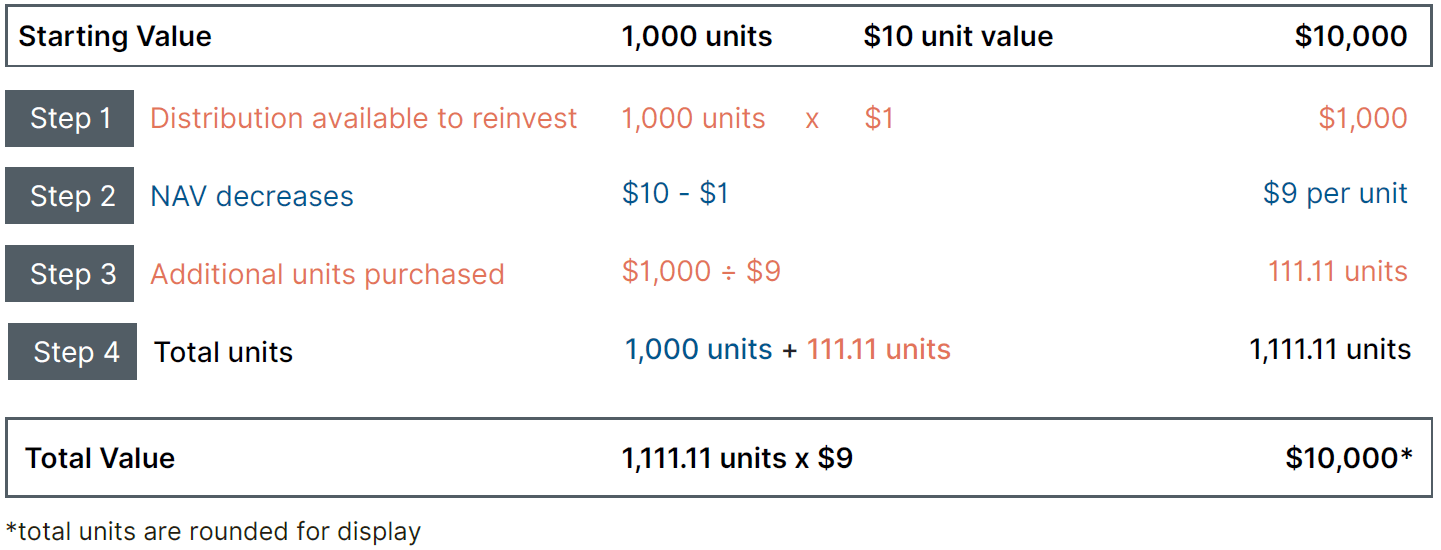
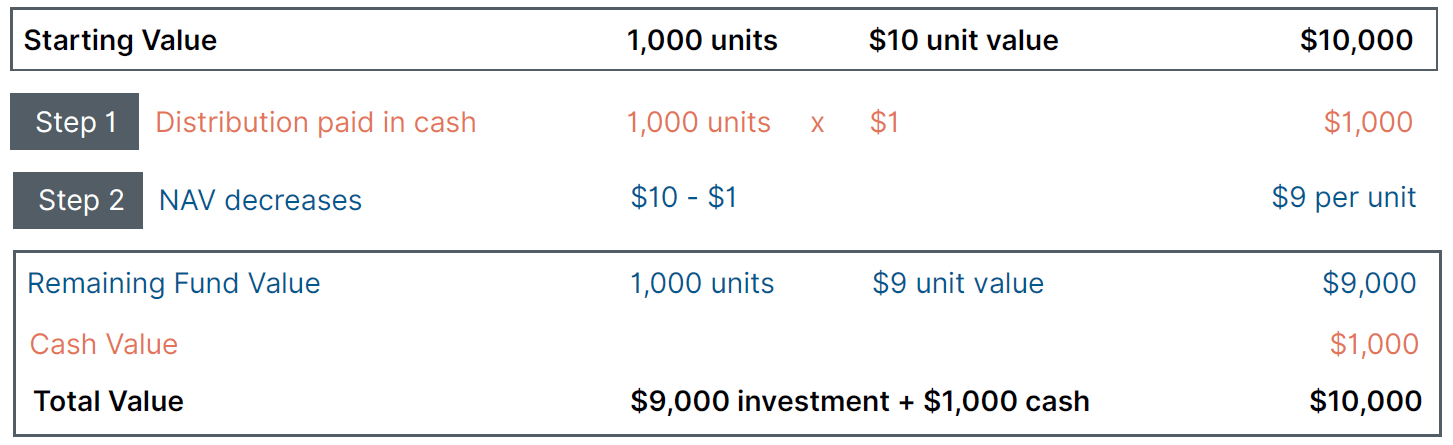
When a fund makes a distribution, its net asset value, or NAV, declines by the amount paid out. That decline does not represent an investment loss. The value has either been paid to you as cash or used to purchase additional units in the fund.
There can be a short delay between the two sides of the transaction. Depending on the institution holding your account, you may see the NAV decline 24 to 48 hours before the cash or additional units appear on your statement.
The example below shows what happens when a distribution is taken as cash or reinvested.
Taking Distributions as Cash
Reinvest the Distribution