


 blog
blog
In 1962, two nearly identical retail concepts opened their doors within months of one another. One discount variety store in Garden City, Michigan welcomed customers under the banner of Kmart. The other was Wal-Mart Discount City in Rogers, Arkansas, the brainchild of Sam Walton.
For the next twenty-five years, Kmart was the clear winner. By 1987, Kmart operated roughly twice as many stores as Walmart, had a nationwide footprint vs. Walmart’s regional focus, and generated substantially more revenue. It was syndicated on television and immortalized by its blue light specials, a merchandising machine.
But something else was happening beneath the surface. In 1966, Sam Walton attended an IBM seminar on computerized inventory tracking and came away convinced that logistics, not just merchandising, would be instrumental in determining the future of discount retail. Walmart began digitizing its supply chain almost immediately, eventually investing in a proprietary satellite network to synchronize sales data across every store in real time.
In 2002, Kmart had filed for the largest retail bankruptcy in history. Walmart, by then, was generating more than five times Kmart's revenue.
Executives, consultants, and business-school case studies have spent three decades picking over the wreckage, pointing to leadership, technology, culture, capital allocation, bad luck, and a host of other issues. All fair. But underneath each of these explanations lurks something more fundamental: a label.
Kmart’s clear identity as a merchandiser competing on price and assortment served wonderfully in honing focus, but this label eventually curdled into a liability when the battlefield in retail moved to the less glamorous plumbing of distribution and data. Heavy investments in IT and logistics just weren’t things that discount variety stores were supposed to do.
This article explores where our attachment to labels comes from, how labels can turn from useful to dangerous, introduces the concept of integrative thinking, and takes a hard look at whether "quality," one of the most durable investment styles of the past several decades, still holds up in a decidedly different world. We close with some ideas for what, in practice, it takes to hold a label firmly without grasping it too tightly.

Why labels exist
So why do we use labels in the first place?
The answer lies deeply rooted in our genetic makeup. Over hundreds of millions of years, evolution has optimized for survival rather than precision. Our sensory systems take in something on the order of a billion bits of information per second, yet the mind can consciously attend to only a sliver of it at any moment. One group of researchers at Caltech recently put the rate of conscious thought at roughly 10 bits per second.
In other words, the oldest inherited parts of our brain were built for cognitive compression to filter out the vast majority of information. Faced with uncertainty, we rely on heuristics, i.e., shortcuts to allow us to make a decision quickly. Enter the label.
The value of labels has been baked into modern systems, too. Consider a busy intersection: in theory, a socially optimal way to prioritize traffic might be to work out which drivers were in the greatest rush and let them go first. But that would be chaos. The red, yellow, green framework is far simpler.
Figure 1: Traffic Light Tree
(Luckily, this is a sculpture in London and not a functioning set of traffic signals!)

Labels save time. They reduce friction and support coordination. And they help us act in a world awash with signal.
When labels become problematic
Behaviourally, the trouble starts when labels stop functioning as tools and start functioning as identity.
In his worthwhile book Influence: The Psychology of Persuasion, Professor Robert Cialdini demonstrates that once you make a public commitment to a position, you become more likely to defend it, even when new evidence should weaken your confidence. Consistency has social value: it signals seriousness and avoids embarrassment. But it also raises the cost of changing your mind.
Labels can also serve as ready excuses. A personal example: I like to think of myself as an aggressive golfer. When facing an intimidating approach to a green that requires a long carry over a water hazard, this label encourages me to attempt the heroic shot despite a small probability of success (usually while quoting Braveheart), when the statistically better option is to lay up. And when I inevitably plonk my ball in the pond, that’s ok. I was being myself; I was being aggressive.
Over time, labels can become decision rules. And the sequence is worth contemplating: the label leads to the bias, which in turn precedes the behaviour.
In investing, this dynamic is easy to miss because our labels often sound sophisticated and fit for purpose. A team may define itself as growth or value-oriented, top-down or bottom-up, or long-term. None of these are wrong or problematic. We believe strongly in the value of North Stars and clearly articulated beliefs—but they can become issues if those labels harden into rigid boundaries.
Should a self-described value investor ignore every investment opportunity with a price-to-earnings ratio above a certain fixed threshold? Should quality-focused investors who may have shunned commodity businesses over the past fifteen years maintain that dogmatic posture and ignore the industry indefinitely, regardless of how the environment has evolved? Should a self-described bottom-up investor ignore big macro events entirely? And should an investor who identifies as having a “long-term” label avoid changing their mind on a very recent investment, even when the facts have changed?
In practice, these are often artificial choices.
The power of AND
If labels create false binaries, what is the alternative?
A Mawer portfolio manager, Peter Lampert, recently shared a worthwhile read on this topic: The Opposable Mind: How Successful Leaders Win Through Integrative Thinking by Professor Roger Martin. Martin shows how better thinkers resist the urge to collapse difficult problems into either/or choices too quickly. Instead, they hold opposing ideas in tension long enough to arrive at a better answer.
Integrative thinking asks more of us. Martin describes four broad features of integrative thinking: salience, causality, architecture, and resolution.
- Salience is what we choose to notice. Labels influence salience by telling us, often implicitly, which facts deserve attention and which do not. Integrative thinkers tend to widen what is salient.
- Causality is how we think the relevant pieces connect. Once a label is in place, it often brings a ready-made story with it: simple, unidirectional relationships. Integrative thinkers tend to challenge heuristics in embracing relationships that are causal and more complex.
- Architecture is how we structure the problem itself. Do we break it into isolated pieces, or do we hold the whole in mind while examining the parts? While simplifying and resorting to specialization make things easier to grasp and more efficient, integrative thinkers refuse to lose sight of the forest even while pruning individual trees.
- Resolution is how we ultimately respond to tension. Do we force a trade-off, or do we look for a better, more optimistic, or more creative synthesis?
And very often, this final resolution results in a path forward that resists what was initially framed as a trade-off.
Consider Sam Walton again, this time through the lens of Martin’s framework. Kmart's leadership had implicitly accepted a trade-off: that a discount retailer couldn’t invest significantly in operations or technology. Walton simply refused that choice.
- He widened what he considered salient to retail success to include something most of his rivals treated as background noise: real-time inventory data.
- He rejected the simple story that good products and good prices were sufficient causes of retail success in favor of a messier one, where operational efficiency quietly determined what prices were even possible.
- Critically, he never let the merchandising instincts that built Walmart's early growth get walled off from its technology investments: the whole business, front of house and back office, stayed in view at once.
Case study: Quality investing
Let’s return to investing.
“Quality” is a label itself: a useful shorthand for durable and competitively advantaged business models, resilient economics, prudent capital allocation, and the capacity to consistently generate high returns on capital and compound wealth over time. The approach is common-sense, rooted in logic, and over the long-term, has proven highly successful.
Figure 2: Quality’s historical outperformance
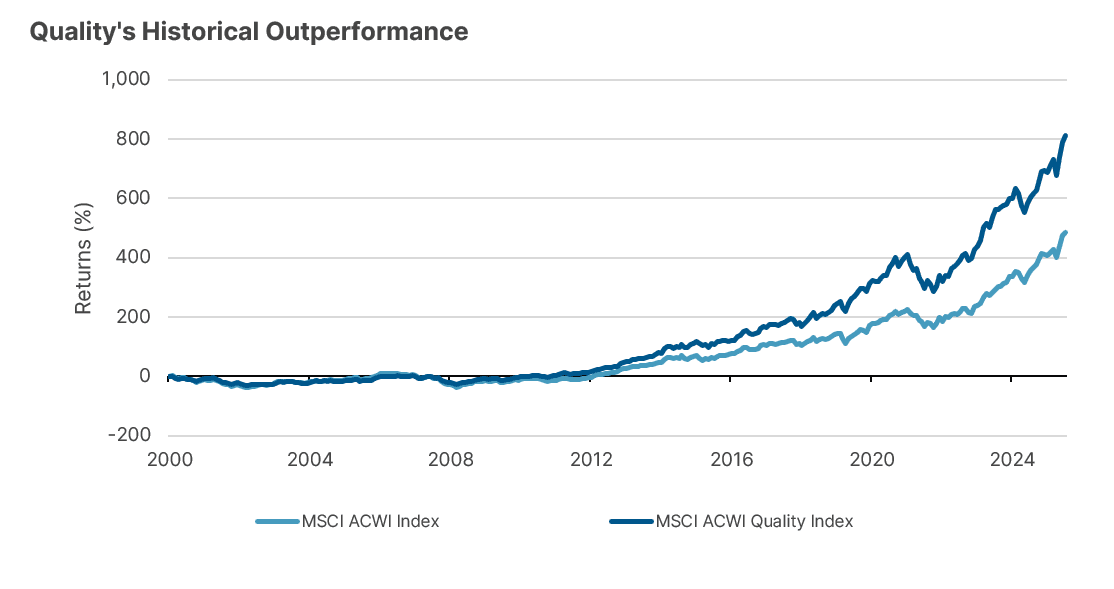
Source: Mawer Investment Management Ltd. Methodology: The chart compares the cumulative growth of the MSCI ACWI Index (Net) and MSCI ACWI Quality Index (Net) using monthly total return data from January 1, 2001 to June 30, 2026. Both series were rebased to a common starting point at the beginning of the period, with monthly returns compounded over time to illustrate relative wealth creation.
However, despite this long history of success, quality-oriented indices have underwhelmed their broader counterparts over the past few years.
Figure 3: Quality’s short-term variance
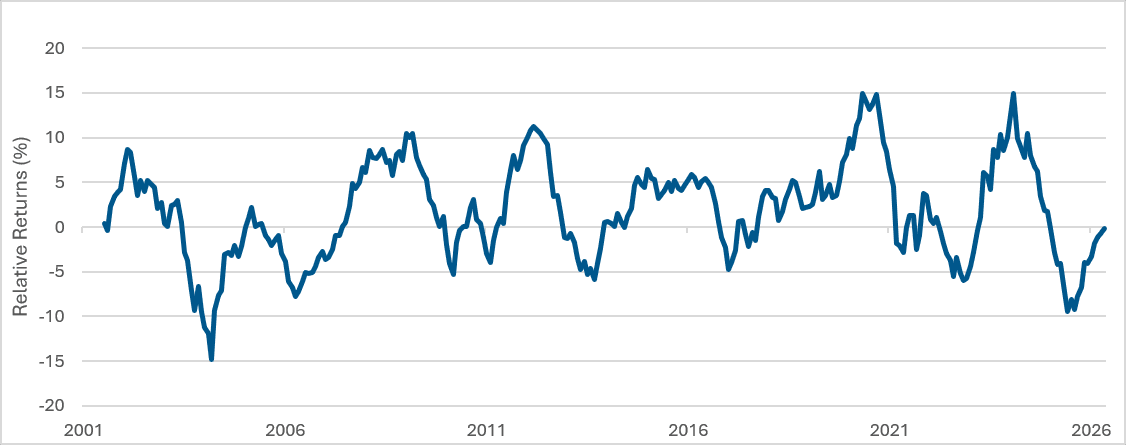
Source: Mawer Investment Management Ltd. Methodology: The chart plots the difference between the 1 year rolling returns of the MSCI ACWI Quality Index (Net) and MCSI ACWI Index (Net), on a monthly basis. Performance is in Canadian dollars.
Drilling down a bit further, the stocks of companies experiencing near-term profit inflections (e.g., semiconductors, commodities, banks), often underrepresented in quality-focused benchmarks, are outpacing those with historical stability (e.g., software) by a greater margin than we’ve ever seen.
Figure 4: Profit inflections vs. profit stability
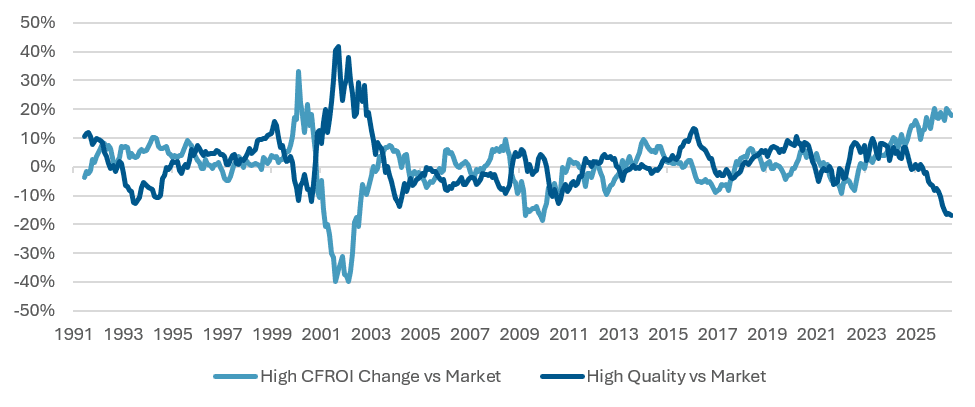
Source: UBS HOLT, the BLOOMBERG PROFESSIONAL services. Data as of June 30, 2026. Universe comprises the top 1000 US companies by market cap, with region-relative factor percentiles used to form equally weighted quintiles, rebalanced monthly. Returns shown are rolling 18-month long/short factor returns, calculated as the return of the highest quintile less the return of the lowest quintile for each factor. The High CFROI Change factor represents companies that have experienced the largest changes in Cash Flow Return on Investment (CFROI), and the High Quality factor represents companies with historically high and stable CFROI.
Should quality-focused investors remain fixed on the approach that had been so successful throughout most of the last 30 years, confident that past relationships should re-establish themselves? Through this lens, doubling down on the types of companies that performed so well previously and that have historically demonstrated high ROICs might be the right call … with the further benefit of being able to purchase them today at much more attractive relative valuations.
Or should quality-oriented investors chart a different course instead, recognizing that the post-COVID period has ushered in a different era? After all, the interest rate regime has shifted sharply higher. AI is accelerating competitive change across industries, and the rules-based global order and period of relative peace that followed the Second World War have reversed alongside what once used to be reliable assumptions for stable globalization, low inflation, and low capital intensity.
Wait. Can’t it be … both?
We’d argue that in looking at individual businesses the familiar questions remain entirely still relevant: where are the real competitive advantages, how durable are they, what returns can be earned on incremental capital, and are management teams allocating that capital with discipline? These questions still anchor our bottom-up process, even as the world has become more noisy and complex.
But it also means adapting —to borrowing here from Canadian Prime Minister Mark Carney—"Nostalgia is not a strategy.” There is a relentless need to be forward-looking in assessing business quality. Anchoring on a company’s historical ROEs or ROICs to define what constitutes a “quality” business risks calcifying the label, introducing the chance for both false positives and false negatives. There are software companies that will struggle to replicate the same degree of fundamental performance going forward. Banks are much more profitable in a higher-rate environment. And beyond Kmart, there are much more recent examples of how a rear-view mirror lens on quality can look very different from a forward-looking view.
Consider the investment case for European defense contractors. Pre-2022, defense spending as a percentage of GDP was historically low in the context of the past few centuries. Since the Cold War, governments and competitors had under-invested in land defense systems (e.g., NATO’s armored backbone still rests on tank designs first drawn up in the 1970s), focusing instead on softer capabilities such as cyber. Returns on investment hadn’t generated wealth for decades. Companies like Germany’s Rheinmetall or Italy’s Leonardo hardly screamed “quality”.
But the Russian invasion of Ukraine was a watershed inflection point, fundamentally shifting the outlook for defense spending, discount rates, the pricing environment, and the impact of supply/demand dynamics on business terms, working capital intensity, and ROIC. Investors who stuck to their heuristics of “defense = low quality” or who sought evidence of wealth-creation in the rear-view mirror missed this seismic shift.
A different regime calls for refinements to the quality playbook: broader diversification, relentless curiosity, and a willingness to respond as probabilities shift rather than anchoring on yesterday’s conditions. Patience remains essential, but so does agility when the facts change.
How to cultivate integrative thinking

A very different example makes the same point. When Steven Spielberg was preparing Jurassic Park, the dinosaurs were meant to be brought to life through stop-motion animation, the craft in which Phil Tippett had spent his career. Then Spielberg saw an early computer-generated test and decided to go digital instead. Watching his entire discipline appear to vanish overnight, Tippett quipped "I think I’m extinct," a line good enough that Spielberg found a way to insert it into the film.
Except … Tippett didn’t go extinct. His team built what became known as the Dinosaur Input Device: a physical, sensor-laden armature that let traditionally trained animators drive the digital dinosaurs by hand. The tactile knowledge of movement that made his work distinctive was fed into the new medium. The result won an Academy Award, and Tippett was anything but extinct. He had found the “and.”
If labels can narrow judgment, the practical question is what to do about it. No investor will ever operate without categories/labels, but to reduce the chance that simplification becomes captivity requires habits, structures, and a culture that make it easier to notice when a label has outlived its usefulness.
Widen the frame
One useful starting point is to broaden salience: individually, and structurally. Integrative thinkers take a wider view of what might matter, resisting the temptation to let the initial frame determine the evidence set. That sounds obvious, but it is surprisingly hard in practice.
One of the tools we use in this regard is our discounted cash flow models, which are stochastic in nature through Monte Carlo simulation. Not only does the output of such an approach force us to think in terms of probability distributions as opposed to single-point outcomes, but the process of building the DCF—of constantly being exposed to the impact that individual inputs have on shaping distributions—embeds a discipline of widening salience that permeates into everything else we do, including more qualitative assessments of competitive advantages or management teams. To borrow from Roger Martin, we embrace the mess.
Figure 5: Monte Carlo DCF
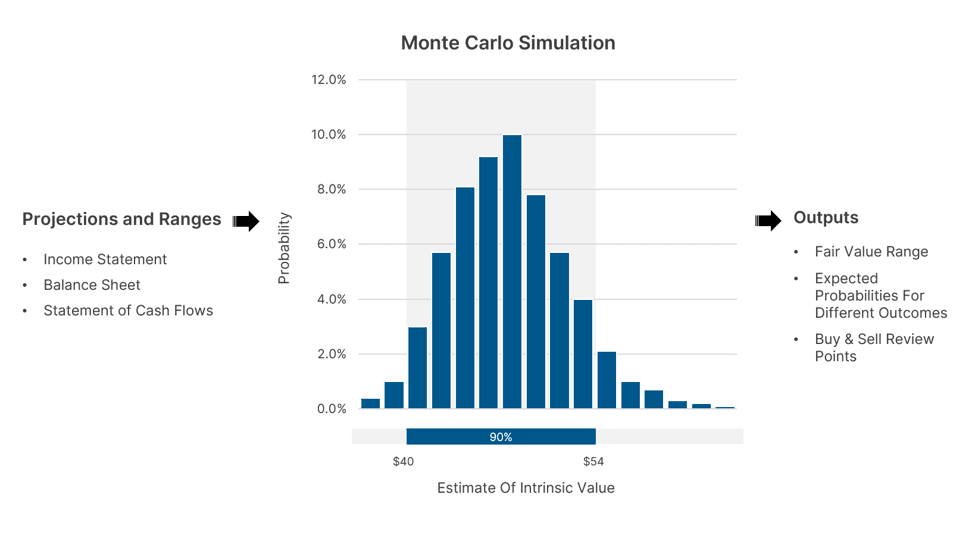
Source: Mawer Investment Management
But no single mind, however disciplined, can hold a genuinely wide frame alone. Martin quotes designer Bruce Mau on this point: "You can't make a Renaissance person anymore, because the range of what you would need to do is just impossible. But you could actually assemble a Renaissance team." A team built from a host of different backgrounds and life experiences is simply better at noticing what a single mind would screen out by habit. Better teams widen what is salient, challenge simplistic causality, and improve the architecture of decisions.
Make it safe to be wrong
Humility matters as well. It is difficult to learn when we assume we already understand the problem. Curiosity is a critical virtue in investing, especially during inflection points. According to Martin, this “assertive inquiry” demands careful choices around language, too. Leading questions (“Wouldn’t you agree that …”) are less likely to surface alternate viewpoints. Calling a stock that you cover “my stock” has the effect of tying you to the idea. As Mawer portfolio manager Paul Moroz likes to say, the stock doesn’t know that you own it.
Culture matters here, too. Teams need room to question cherished priors without treating that as disloyalty to process, philosophy, or one another. Pixar has built an entire institution around this same instinct. Every film in production is regularly submitted to the "Braintrust," a small group of senior directors who give unvarnished, sometimes brutal feedback on unfinished work with clear governing rules: the critique targets the film, never the filmmaker, and the director retains final say over what to do with it. The Braintrust works precisely because candor has been separated from hierarchy and blame.
Track the record, not just the memory
Finally, mistakes can be useful teachers but only if they are examined honestly. There's a natural temptation, in any field, to stay inside the terrain where our existing labels let us feel competent—to build a portfolio of experiences that quietly reinforces the original stance rather than testing it. The better path is usually less comfortable. To borrow a less elegant phrase, one Martin himself has used: sometimes the right answer is to embrace the suck.
This, too, can be made concrete and dispassionate. Philip Tetlock’s work on superforecasting suggests that judgment can improve when it is measured, compared, and revisited. Forecasts can be tracked. Assumptions can be made explicit. Changes of mind can be examined rather than hidden. If labels create overconfidence by making our categories feel natural and fixed, then measurement can help restore some humility: better resolutions and not just better guesses.
Conclusion
Labels will keep doing what labels do, and that is no flaw to engineer away. They cut through a world of too much information and too little certainty, and direct attention to what matters. A traffic light works precisely because no one deliberates at the intersection: the rule decides, and everyone moves.
The trouble comes when the rule stops matching the road. The same shortcut that lets us move without deliberating can, applied past its usefulness, harden into a fixed set of rules followed out of habit, until the label is answering questions it was never equipped to settle.
When that happens, the easy move is to treat it as a binary: hold the label rigidly and ignore what does not fit, or abandon it and start from scratch.
Integrative thinking refuses that choice. It looks at the label and at everything the label ignores, holds both in mind and stays with that discomfort and tension long enough to find an answer that works for both. What it arrives at is usually not a compromise, but a third option that neither side would have reached on its own.
Sam Walton never stopped being a merchandiser; he simply refused to accept that a merchandiser could not also build a logistics company and built both at once. He did not let the label decide for him. He embraced the “and.”
Disclaimers
This publication is solely intended for informational purposes and should not be construed as individualized investment advice, research, or a recommendation to buy, sell or hold specific securities. Information provided reflects current views based on data available at the time or writing and may change without notice. Mawer Investment Management Ltd. and/or its clients may hold positions in the securities mentioned, which may create a potential conflict of interest. While efforts are made to ensure accuracy, Mawer Investment Management Ltd. does not guarantee the completeness or accuracy of this information and disclaims liability for any reliance placed on the publication. Mawer Investment Management Ltd. is not liable for any damages arising out of, or in any way connected with, its use or misuse.
The MSCI information may only be used for your internal use, may not be reproduced or disseminated in any form and may not be used as a basis for or a component of any financial instruments or products or indices. None of the MSCI information is intended to constitute investment advice or a recommendation to make (or refrain from making) any kind of investment decision and may not be relied on as such. Historical data and analysis should not be taken as an indication or guarantee of any future performance analysis, forecast or prediction. The MSCI information is provided on an “as is” basis and the user of this information assumes the entire risk of any use made of this information. MSCI, each of its affiliates and each other person involved in or related to compiling, computing or creating any MSCI information (collectively, the “MSCI Parties”) expressly disclaims all warranties (including, without limitation, any warranties of originality, accuracy, completeness, timeliness, non-infringement, merchantability and fitness for a particular purpose) with respect to this information. Without limiting any of the foregoing, in no event shall any MSCI Party have any liability for any direct, indirect, special, incidental, punitive, consequential (including, without limitation, lost profits) or any other damages. (www.msci.com)